
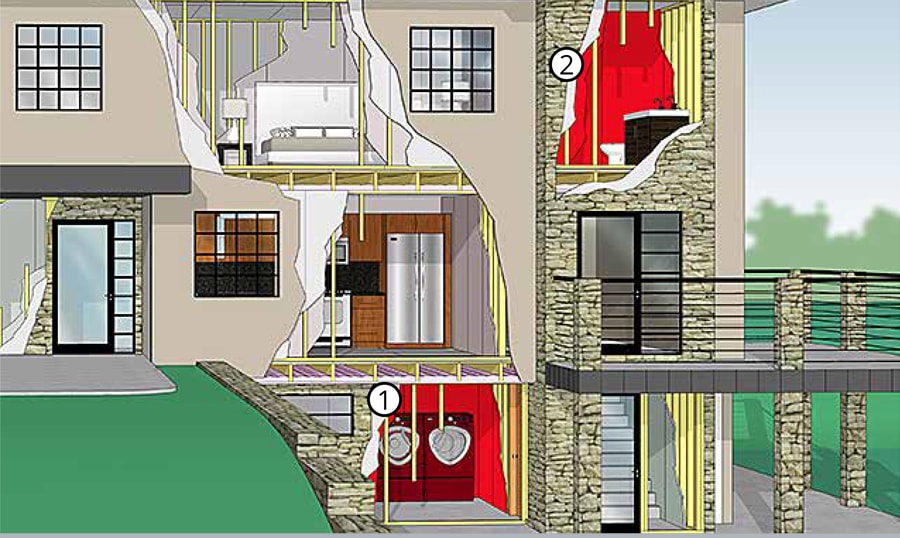
1. Basement/Laundry Room 2. Bathroom
Mold/Moisture-Resistant Gypsum Panels are an important component in moisture protection.
Mold/Moisture-Resistant Gypsum Panels are typically available in 1/2” (12.7 mm) or 5/8” (15.9 mm) thicknesses, widths of 48” (1.2 m) or 54” (1.4 m) and lengths from 8’ (2.4 m) to 16’ (4.9 m). Conforming to the product standard ASTM C1396, Mold/Moisture-Resistant Gypsum Panels are produced in three variations – a 1/2” standard version, a 1/2” Type C option and a more common fire-resistant 5/8” Type X choice. All these variations are manufactured with a specially formulated core enhanced with additives to help it repel water and discourage microbial growth. The core is wrapped in either treated moisture- and mold-resistant paper facers or fiberglass mats that are naturally resistant to water absorption and mold growth. Edges are generally tapered like most other drywall panels to simplify finishing joints.
Because moisture damage can start inside wall cavities where it isn’t visible until extensive repairs and remediation are required, Mold/Moisture-Resistant Gypsum Panels are becoming an increasingly common homebuyer expectation. But these products also offer a range of other valuable benefits as well.
To achieve the design and performance objectives specified for the walls and ceilings of your commercial project, a number of important limitations should be followed to ensure success. These recommendations are intended to provide general information only about considerations that are common in this category of special performance gypsum products:
Refer to GA-216 Application And Finishing Of Gypsum Panel Products.
Products vary by brand. For more specific limitations related to the gypsum panel you are considering, consult with the product’s manufacturer.
Below are answers to typical questions our technical experts address on a routine basis. These answers may provide additional information you are seeking as well. To submit an inquiry of your own, click here.
I understand that even Mold/Moisture Resistant Gypsum Panels should not be used in so-called “wet areas.” Can you explain where this product can and cannot be used?
Mold/Moisture Resistant Gypsum Panels are excellent for use in high humidity areas and even where an occasional splash of water is expected. Appropriate areas include powder rooms, adjacent to showers or tubs, behind counter areas/base cabinetry where plumbing fixtures are located, and in laundry rooms, mud rooms, etc.. However, neither the model codes nor the Tile Council of North America’s (TCNA) Handbook allow for the use of these boards behind the tile in the shower or tub area or as a base under the pan or around a swimming pool or sauna. For acceptable materials in wet areas, consult the local code or the TCNA.
Are any special precautions recommended when moisture/mold resistant board is applied as a finished wall surface in below grade basements?
Yes, care must be taken to ensure that no moisture migrates through the walls. Refer to GA-216 for installation recommendations.
3. Are any special precautions recommended when moisture/mild resistant board is applied to unheated HVAC, mechanical or storage areas?
Yes, unconditioned spaces can experience great swings in temperature leading to condensation. Refer to GA-216 and consult with your preferred supplier for product recommendations.
To read more about the testing procedures to evaluate the moisture-resistant characteristics of the core and facers of a gypsum panel product, refer to ASTM C473.
To read more about the testing procedures to evaluate the mold-resistant properties of the core and facers of a gypsum panel product, refer to ASTM D6329.
INTERIOR WALLS Mold/Moisture-Resistant Gypsum Panels are an excellent material specification for interior wall construction in areas where increased protection against the absorption and infiltration of moisture and/or enhanced resistance to the growth of mildew and mold are desired as compared to traditional drywall. This includes areas with periodic, elevated humidity, moisture vapor and dampness levels due to water usage within the space or environmental conditions nearby. Some examples in single-family homes include:
Produced with both Type C and Type X fire-resistant core options, Mold/Moisture-Resistant Gypsum Panels are UL-classified for use in a wide range of fire-rated assemblies to also help address homebuyer expectations for increased fire protection.
INTERIOR CEILINGS Mold/Moisture-Resistant Gypsum Panels are suitable for installation on ceilings in the same environments where they can be used for wall construction and in their fire-resistant core variations for floor/ceiling assemblies where Type C or Type X gypsum panels are approved.
OTHER USES Mold and/or moisture resistance are special-performance properties formulated into many different interior and exterior gypsum products in recent years in addition to their primary design characteristics. Refer to the manufacturer’s information resources for details regarding the mold and moisture resistance of gypsum panel products being considered. Some of these products include exterior sheathing, abuse-resistant gypsum panels and impact-resistant gypsum panels.
SOUND CONTROL
SOUND CONTROL AND GYPSUM BOARD Managing noise transmission between adjacent spaces in a structure and between interior and exterior is a vital design consideration. As a component part of many different wall and floor/ceiling assemblies, gypsum panel products can contribute significantly to a solution. Learn about basic sound-control concepts, noise-attenuation strategies, effectiveness classifications and the beneficial value of gypsum panel products. more