
If you’re an architect, engineer, or contractor specifying gypsum products, you’ve likely come across the term ESR: Evaluation Service Report. But what exactly is it, and why does it matter for your projects?
What Is an ESR?
An ESR is an official document, most commonly issued by the ICC Evaluation Service, that demonstrates a specific building product, material, or system complies with the requirements of model building codes such as the International Building Code (IBC) or International Residential Code (IRC).
Why It Matters on Your Projects
ESRs exist to make the code compliance process faster and more reliable for everyone involved:
- Proof of safety: ESRs confirm that new or unique products meet code-required safety standards.
- Faster approvals: Building officials can rely on an ESR rather than reviewing hundreds of pages of underlying test data, speeding up plan review and inspections.
- A trusted shortcut: For engineers and builders, an ESR provides a straightforward way to document code compliance without reinventing the analysis project by project.
What’s Inside an ESR
A typical ESR includes:
- Product description: what the product is and its intended function
- Applicable code sections: which parts of the code govern its use
- Installation requirements: specific directions for safe, compliant installation
- Limitations of use: conditions and boundaries, such as fire ratings or wind load limits
A Few Things to Keep in Mind
ESRs are typically most relevant for new or innovative products not yet explicitly “recognized” within the I-Codes. It’s worth noting that an ESR is not explicitly required by the I-Codes, but Authorities Having Jurisdiction (AHJs) will frequently request one as documentation that a specified product meets code, so having one on hand can help keep your project moving.
A Real-World Example: GA’s Newly Reissued ESR-5654
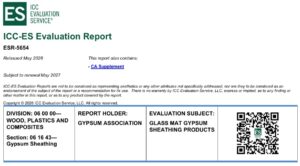
The Gypsum Association’s own ESR-5654, reissued in May 2026, is a good illustration of how an ESR functions in practice. This report covers glass mat gypsum sheathing products and recognizes them for exterior applications, specifically, resisting transverse wind pressures and serving as a component of shear wall assemblies.
For A/E/C professionals, ESR-5654 offers several practical benefits:
- Multi-code coverage: It confirms compliance across the 2012 through 2024 editions of the IBC and IRC, so it stays relevant regardless of which code cycle your jurisdiction has adopted.
- Structural design data: Tables in the report provide allowable transverse wind loads and shear wall design values by sheathing thickness, fastener type, and spacing, figures engineers can reference directly for wall design.
- Prescriptive and engineered paths: The report addresses both prescriptive wall bracing (Method GB) and engineered shear wall design, giving flexibility depending on project needs.
- California supplement included: For projects in California, the report includes a CA Supplement confirming compliance with the 2022 CBC and CRC.
When specifying glass mat gypsum sheathing, referencing ESR-5654 gives architects and engineers a documented, code-recognized basis for their designs, and gives building officials the confidence to approve it quickly.